Article snapshot
- Focus
- Competence
- Summary
- United States v. Maloney is a compact but powerful Ninth Circuit case about improper rebuttal, trial fairness, issue preservation, and prosecutorial ethics. It shows both how defence counsel should respond when the prosecution injects a new factual theory in rebuttal and how a prosecutor’s office should act when it later concludes the conviction was obtained unfairly.
- Primary issue
- Improper rebuttal argument, fair trial process, surrebuttal, issue preservation, prosecutorial ethics
- Jurisdiction
- United States, Ninth Circuit
- Court / tribunal
- United States Court of Appeals for the Ninth Circuit (en banc)
- Case / matter
- United States v. Maloney
- Citation / file no.
- 755 F.3d 1044 (9th Cir. 2014) (en banc)
- Statute / rule
- California Rules of Professional Conduct rr. 1.1, 1.3, 3.1, 3.3, 3.4, 3.8
- Who this helps
- criminal defence lawyers, prosecutors, appellate lawyers, trial lawyers, legal ethics scholars, law students
- Key takeaway
- When the prosecution raises a new and unproved factual premise in rebuttal, defence counsel should object immediately, seek a concrete remedy, and make a clear record of prejudice; prosecutors, for their part, must not use rebuttal to smuggle in facts outside the record.
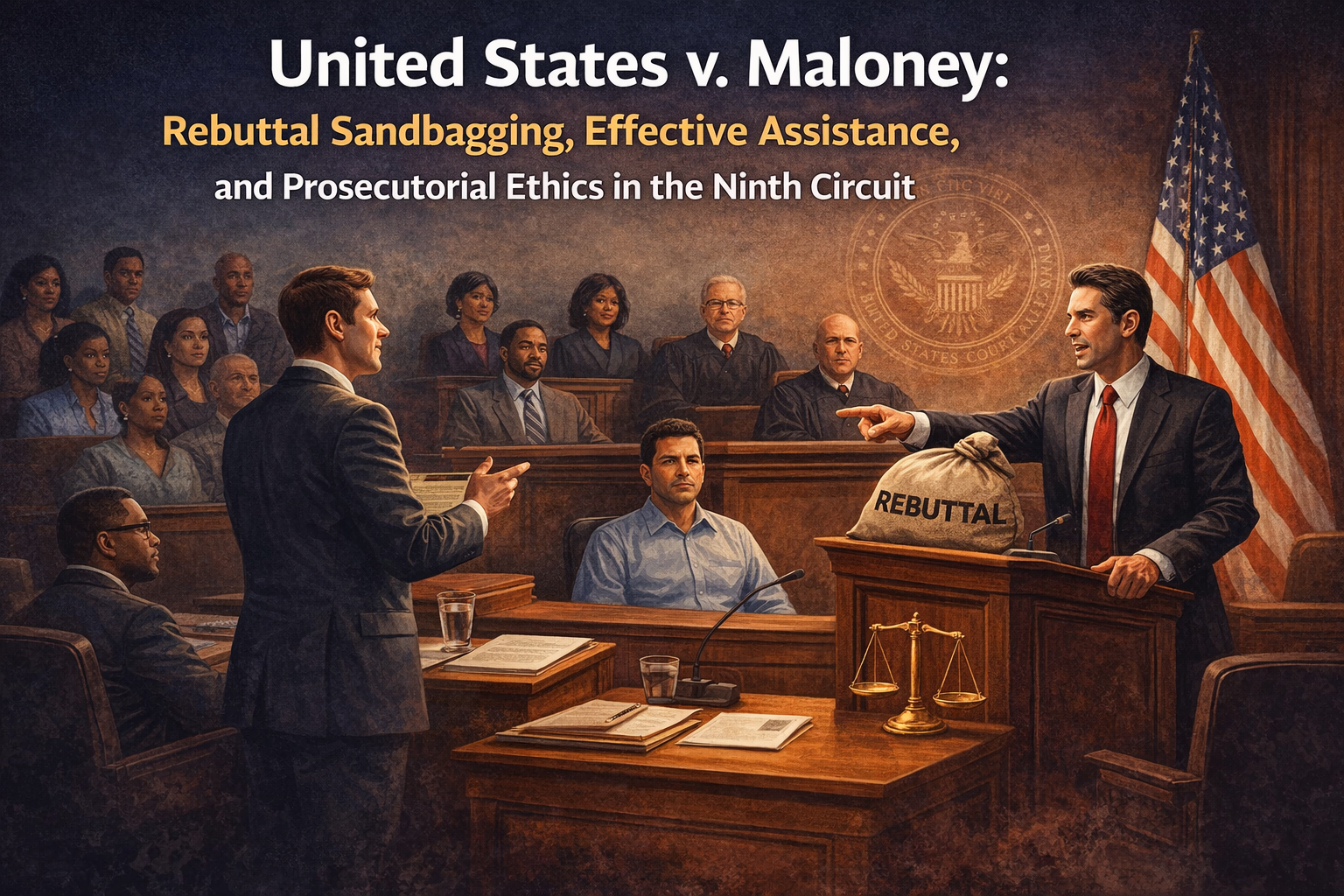
United States v. Maloney: Rebuttal Sandbagging, Effective Assistance, and Prosecutorial Ethics in the Ninth Circuit
United States v. Maloney, 755 F.3d 1044 (9th Cir. 2014) (en banc), is an unusual criminal appeal. The published en banc disposition is short because, after the en banc oral argument, the U.S. Attorney’s Office reviewed the video, concluded that “no reference should have been made to luggage in rebuttal argument,” and moved to reverse the conviction, vacate the sentence, and remand. The Ninth Circuit granted that motion and expressly commended the office. That makes Maloney less a sprawling doctrinal opinion than a compact but powerful lesson in trial fairness and professional responsibility. (Ninth Circuit Court of Appeals CDN)
The facts were straightforward. Border Patrol stopped John Maloney at a checkpoint in Imperial County and found 112 packages of marijuana, weighing 321.33 pounds, in the bunk area behind the driver’s seat of his tractor-trailer. The only real issue at trial was knowledge. Maloney testified that he thought he was hauling a legitimate load and had been duped into transporting drugs without knowing they were in the cab.
The problem arose in rebuttal closing. There had been no evidence at trial about whether Maloney had luggage. Yet, for the first time in rebuttal, the prosecutor argued that Maloney must have been lying about the trip because he had no luggage, and that the jury could infer guilty knowledge from that point. Defense counsel immediately sought surrebuttal—a brief chance to answer the new point—twice, and then moved for a mistrial. All three requests were denied.
For accuracy’s sake, it matters to say exactly what Maloney is and is not. The en banc court did not write a long merits opinion announcing a broad new rule about surrebuttal. The operative disposition came after the government conceded error. To understand the doctrinal fight, you have to read the en banc order alongside the earlier panel opinion, 699 F.3d 1130 (9th Cir. 2012), which was later vacated on rehearing en banc. The panel majority affirmed; Judge Gilman dissented; the later concession and reversal effectively validated the dissent’s fairness concerns. I would not oversell Maloney as a sweeping surrebuttal precedent. Its force is narrower, and in some ways more important: it is a case about fair trial process, issue preservation, and prosecutorial ethics.
The core principle is simple: closing argument is not evidence, but it is still bounded by the record. The panel majority correctly stated the black-letter framework. Prosecutors may argue hard and may urge reasonable inferences from the evidence. But rebuttal is not a second opening; it is supposed to answer the defense, not introduce a new theory that the other side never had a fair chance to meet. The same panel opinion acknowledged that denying surrebuttal can be an abuse of discretion when the prosecution raises new issues in rebuttal that the defense did not open and that are not supported by reasonable inferences from the record. (Ninth Circuit Court of Appeals CDN)
Where Maloney becomes especially instructive is in the gray area between invited reply and unfair surprise. The panel majority treated the luggage point as a permissible response because defense counsel had argued broadly that Maloney was credible. The majority even said that defense counsel opens the door to “topics or issues, not specific facts.” But that formulation shows the problem rather than solving it: what made the luggage argument unfair was precisely that it smuggled in a specific factual premise—no luggage—that had never been proved. Judge Gilman’s dissent saw the better point. The prosecutor dramatized the theme with an A Few Good Men analogy, and at panel argument admitted he had “sandbagg[ed]” the defense by saving the point for rebuttal. By the en banc stage, the government itself agreed the luggage argument should not have been made.
The case also teaches the practical importance of standards of review. The panel majority looked at the issue through Hinkson’s highly deferential abuse-of-discretion lens and then through harmless-error review, concluding that the government’s evidence was strong and that the standard instruction telling jurors that lawyers’ arguments are not evidence likely cured any prejudice. The dissent analyzed prejudice differently. Drawing on Hein v. Sullivan and United States v. Sanchez, Judge Gilman emphasized that this case turned on credibility, that the luggage point was featured repeatedly, that the defense had no chance to answer it, and that the jury later asked about the items Maloney had with him when arrested. That is a much more realistic account of how rebuttal can land in a close criminal case.
Effective assistance of counsel
The effective-assistance lesson is important even though Maloney is not, formally, a Sixth Amendment ineffective-assistance case. What it shows is what effective assistance looks like in real time. Defense counsel objected immediately, identified the precise unfairness, asked for the narrow remedy of surrebuttal, explained what the response would have been, and then moved for mistrial when the court refused to cure the problem. That is exactly how competent defense counsel preserves a closing-argument issue for appeal. In practical terms, it is effective assistance before ineffective-assistance litigation ever becomes necessary.
For California practitioners, that point maps neatly onto the Rules of Professional Conduct. Rule 1.1 requires competence; Rule 1.3 requires diligence, meaning commitment and dedication to the client’s interests without neglect or undue delay. Rule 3.1(b) is also worth remembering: a criminal defense lawyer may defend by requiring every element to be proved. In Maloney, knowledge was the only contested element, so insisting that the government prove knowledge with evidence rather than end-of-case innuendo was not technical gamesmanship. It was the defense function working exactly as it should. (The State Bar of California)
The practical takeaway for defense lawyers is clear. When the prosecution raises something new in rebuttal, object on both grounds: outside the record and outside the proper scope of rebuttal. Ask for a concrete remedy—surrebuttal, a curative instruction, or both—and make an offer of proof. Then explain prejudice in the vocabulary appellate courts use: this was a credibility case, the argument came last, and the defense had no fair chance to respond. Maloney shows why that level of precision matters.
Ethics
The ethical lesson for prosecutors is even more powerful. After the en banc argument, United States Attorney Laura Duffy and senior lawyers in the office reviewed the video, concluded that the luggage argument should not have been made, and moved to reverse. The office also told the court it would use the argument video as a training tool. The Ninth Circuit responded by returning to first principles from Berger and Kojayan: a prosecutor’s duty is to seek justice and to win fairly. Maloney is therefore not just a misconduct case. It is a rare published example of a prosecutor’s office correcting a conviction because fairness required it.
That same idea has a California analogue. Rule 3.8 says a prosecutor has special responsibilities, and its comment describes the prosecutor as “a minister of justice and not simply that of an advocate.” Rules 3.3 and 3.4 reinforce the same theme of candor and fairness in litigation. Maloney was not a Brady case and it was not about hidden documents. But the ethical instinct is the same: do not smuggle an unproved factual premise into rebuttal, and do not use the tactical advantage of the last word to deny the defense a fair chance to answer. (The State Bar of California)
There is a second prosecutor’s lesson as well. If a point matters, prove it. Judge Gilman emphasized that there was no evidence at trial about whether Maloney had luggage and that the prosecutor could have asked him about it on cross-examination. That is exactly right. What the government could not do fairly was convert silence in the record into a new rebuttal theme and then claim the defense had opened the door. And if an office later concludes that a conviction was obtained unfairly, Maloney shows the model response: acknowledge the error, correct it publicly, and train so it does not recur.
Bottom line
Maloney is a short disposition with unusually high teaching value. It brings together doctrine, preservation, standards of review, trial advocacy, appellate advocacy, and legal ethics in one appeal. It also reminds us that oral argument can matter in a very real way: the government later said it reviewed the en banc video before changing its position. That makes the Ninth Circuit’s video worth linking not just because it is lively, but because it appears to have helped change the case itself. (Ninth Circuit Court of Appeals Video)
Questions this post answers
Why is Maloney important for criminal defence lawyers?
Because it shows exactly how counsel should preserve an unfair rebuttal issue: object immediately, identify that the point is outside the record and outside the proper scope of rebuttal, seek surrebuttal or another concrete remedy, and explain the prejudice clearly.
Why is Maloney important for prosecutors?
Because it is a rare published example of a prosecutor’s office reviewing the case after argument, conceding that the rebuttal point should not have been made, and moving to reverse the conviction in the interest of fairness.
Does Maloney create a broad new rule about surrebuttal?
No. The article correctly treats its force as narrower. Its main value is as a lesson in fair trial process, preservation, rebuttal limits, and prosecutorial ethics, not as a sweeping standalone surrebuttal precedent.
What is the practical lesson from Maloney?
If a point matters, prove it with evidence. Do not wait until rebuttal to introduce a factual premise the other side has had no fair chance to answer.